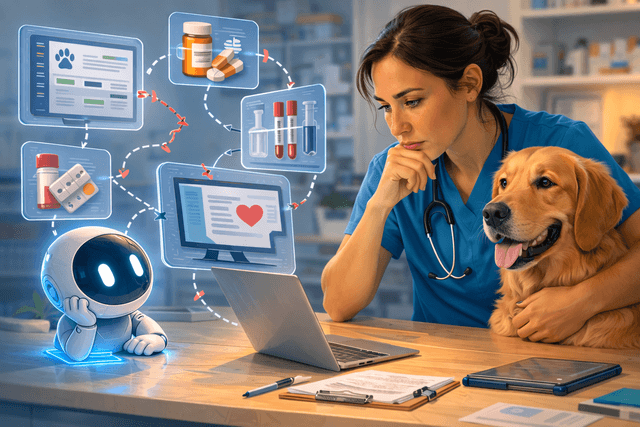
The AI Agents Conversation
There’s a lot of talk right now about AI agents in veterinary medicine.
Systems that can monitor workflows, make decisions, and automate operational tasks.
The excitement makes sense. AI agents have the potential to coordinate complex workflows in ways traditional software never could.
But when you start hearing people talk about AI agents transforming veterinary medicine, it raises a fairly obvious question.
How would that even work?
Because AI agents don’t operate inside isolated software tools.
They operate across connected systems.
And today, veterinary medicine largely runs on systems that don’t talk to each other.
AI Agents Don’t Operate in Silos
Most of the AI tools we’re currently seeing in veterinary medicine are assistive tools.
Diagnostic imaging analysis. Documentation tools. Clinical note generation.
These tools work because they operate inside a single system.
AI agents are different.
They’re designed to monitor workflows and take action across multiple systems when certain conditions occur.
But that raises another question.
What systems would an AI agent actually interact with in veterinary medicine today?
Because most veterinary software environments are still highly fragmented.
The PIMS Problem
Practice Management Systems sit at the center of the veterinary technology stack.
They hold the patient records, appointment schedules, billing data, and treatment history that drive nearly every workflow inside a practice.
But many PIMS platforms were not built with open interoperability in mind.
Some operate as closed environments with limited third-party integrations.
Others provide APIs, but with restricted access that prevents full read and write capabilities.
And in some cases, integrations are tightly controlled or require custom partnerships with the platform itself.
This creates what many in the industry refer to as walled gardens.
Which leads to another obvious question.
How would an AI agent operate across systems if those systems can’t freely exchange data?
Because AI agents don’t operate inside a single application.
They operate across ecosystems.
Veterinary Medicine Is Still a Fragmented Ecosystem
Outside of the practice itself, veterinary workflows extend across multiple systems:
- Pharmacy software systems
- Online pharmacy portals
- Reference labs
- Diagnostic imaging systems
- Insurance platforms
Each of these systems may operate on its own infrastructure with limited integration points.
In many cases, data still moves between them through manual processes.
Fax communication.
Emails.
Phone calls.
Staff manually transferring information between systems.
So when people talk about AI agents orchestrating workflows across veterinary medicine, the next question becomes unavoidable.
What workflow would they actually be orchestrating?
Because in many cases, the workflow itself is still fragmented.
AI Agents Need Infrastructure
AI agents rely on something foundational.
A connected digital infrastructure layer.
A network where data moves between systems in a standardized way and where software platforms can interact programmatically with each other.
Human healthcare built this layer decades ago through electronic prescribing networks and healthcare interoperability frameworks.
Those networks created the foundation where automation and intelligent systems could eventually operate.
Veterinary medicine is still in the early stages of building that infrastructure.
Until systems become more connected and interoperability becomes more common, AI agents will remain largely theoretical across much of the industry.
The Order Matters
Artificial intelligence will absolutely play a role in the future of veterinary medicine.
But the order matters.
First comes connected infrastructure.
Then comes intelligent systems that operate on top of that infrastructure.
AI agents aren’t the starting point.
They’re what becomes possible once the ecosystem itself is connected.
FAQ
What are AI agents in veterinary medicine?
AI agents are systems designed to monitor workflows, analyze data, and take actions automatically across connected software systems. Unlike traditional AI tools that assist with tasks like documentation or diagnostics, AI agents are intended to coordinate operational processes across multiple platforms.
Why can’t AI agents operate widely in veterinary medicine today?
Most veterinary software systems are not deeply connected. Practice Management Systems, pharmacies, labs, and other platforms often operate independently with limited interoperability. Without connected systems and shared infrastructure, AI agents cannot effectively monitor or coordinate workflows.
What role do Practice Management Systems (PIMS) play in veterinary interoperability?
Practice Management Systems sit at the center of the veterinary technology ecosystem. They store patient records, treatment history, billing information, and prescription data. When integrations are limited or APIs restrict read and write access, it becomes difficult for other systems to interact with veterinary workflows.
What is a connected digital infrastructure layer in veterinary medicine?
A connected digital infrastructure layer is a network that allows systems across the veterinary ecosystem to exchange data and interact programmatically. In human healthcare, prescribing networks provide this type of infrastructure. Veterinary medicine is still in the early stages of building similar connectivity.
When could AI agents realistically appear in veterinary medicine?
AI agents will become more viable as interoperability improves across the industry. As systems become more connected and digital workflows become standardized, AI agents will be able to monitor processes and automate tasks across the veterinary ecosystem.