The Confusion in the Market
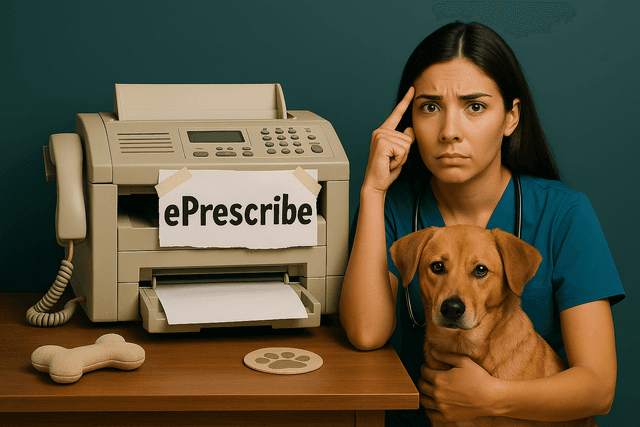
In animal health, more companies are marketing themselves as Veterinary ePrescribing platforms. But in reality, many of these solutions are not true electronic prescribing systems.
Some operate as fax interceptors, capturing faxes from pharmacies, displaying them in a digital-looking dashboard for approval, and then faxing them right back. Others use point-of-care faxing, which allows veterinarians to send prescriptions directly from a "Hub" or digital interface, which is through a fax server instead of printing and manually sending them.
Both models appear modern on the surface, but rely entirely on fax technology behind the scenes. They promise digital convenience but deliver the same inefficiencies that have existed for decades.
This has led to widespread confusion. Veterinarians, pharmacies, and pet owners hear the term “ePrescribing” and assume it means compliance, security, and efficiency. The truth is, faxing masquerading as ePrescribing is not ePrescribing.
What Fax Intercept Solutions Really Do
Some platforms in animal health position themselves as “digital” or “ePrescribing,” but in reality, they are nothing more than fax-intercept systems. Instead of enabling prescriptions to move electronically through a secure network, these platforms:
• Capture faxes from outside pharmacies
• Repackage them in a digital-looking interface for veterinary approval
• Fax them right back to the pharmacy on the other end
The workflow begins as a fax and ends as a fax, no matter how modern the interface looks. This is not electronic prescribing. It is fax with a facelift.
The Risks and Shortcomings Are Significant
• No DEA certification for prescribing controlled substances
• No two-factor authentication for prescribers
• No verifiable audit trail
• No participation in a true prescribing network, leaving pharmacies as isolated endpoints
• No compliance with the 2023 NCPDP SCRIPT standard, the federally recognized framework for transmitting prescriptions electronically
These systems create the illusion of progress but leave veterinarians, pharmacies, and pet owners with the same inefficiencies, compliance risks, and delays that fax has always caused.
The Rise of Point-of-Care Faxing
While fax interceptors disguise incoming faxes as digital requests, point-of-care faxing takes a different approach. It enables veterinarians to fax prescriptions directly from their practice software, giving the appearance of an integrated, streamlined workflow.
At first glance, this may seem like progress. The veterinarian clicks “send,” and the system transmits the prescription through a cloud-based fax server to the pharmacy. But despite its convenience, the prescription is still a fax — not an electronic transmission.
This approach introduces several problems:
- No structured data. Pharmacies receive an image, not electronic prescription data, meaning staff must re-enter information manually.
- No compliance or verification. Because the prescription never travels through a certified Script Exchange, it cannot meet DEA or NCPDP SCRIPT standards.
- Disconnected workflow. Pharmacies receive faxes not linked to any digital order, creating confusion, delays, and additional work.
- Poor accountability. There is no verifiable sender identity, timestamp, or digital confirmation of receipt.
For pharmacies, this means a constant flow of random, unaffiliated faxes with no associated order record. Staff must identify the patient, confirm authenticity, and re-enter details — creating unnecessary workload, transcription risk, and communication bottlenecks.
Why Some Platforms Rely on Fax Wrappers
If fax-based prescribing is so flawed, why do some platforms still use it and market themselves as “ePrescribing”? The answer is simple: it is easier and cheaper than building a true prescribing network.
• Regulatory avoidance. Achieving DEA certification for EPCS requires strict compliance, identity proofing, and ongoing audits. Fax-based systems sidestep this by never actually transmitting prescriptions electronically.
• Lower technical barriers. Building a platform on the 2023 NCPDP SCRIPT standard demands real engineering, interoperability testing, and integration with pharmacies. Wrapping a fax workflow requires none of that.
• Faster market entry. By rebranding fax as “digital,” companies can quickly claim they offer ePrescribing without the time or investment required to deliver the real thing.
• Illusion of progress. A digital dashboard over a fax server looks innovative, even though it does not eliminate fax or ensure compliance.
This shortcut approach may make for slick marketing, but it leaves veterinarians, pharmacies, and pet owners stuck with the same inefficiencies, risks, and lack of accountability that have plagued fax for decades. To understand what true modernization looks like, see how digital connectivity is redefining veterinary prescribing.
What True Veterinary ePrescribing Delivers
True ePrescribing in animal health is not about making fax more convenient. It is about eliminating fax altogether and ensuring compliance, security, and efficiency.
A genuine veterinary ePrescribing solution delivers:
• End-to-end digital transmission. Prescriptions are created, authorized, and sent electronically from veterinarian to pharmacy without faxing at any step.
• Standards-based interoperability. Every prescription is transmitted using the 2023 NCPDP SCRIPT standard, ensuring structured, machine-readable data that integrates seamlessly with PIMS and pharmacy systems.
• DEA compliance and security. Transactions meet all DEA requirements, including two-factor authentication, prescriber identity proofing, and digital signatures for controlled substances.
• Audit and transparency. Each prescription is logged, time-stamped, and fully traceable.
• Efficiency and accuracy. By eliminating transcription errors and reducing callbacks, practices reclaim staff time and improve patient care.
• Network connectivity. Practices and pharmacies connect through a verifiable prescribing network, not an intermediary disguising faxes as electronic data.
This framework has been standard in human healthcare for more than a decade. Learn how this evolution from human to veterinary prescribing is shaping the future through the evolution of ePrescribing.
How to Spot the Difference: Fax vs True ePrescribing
With so many companies in animal health claiming to offer ePrescribing, knowing what to ask can make all the difference.
• Start with compliance. Any true veterinary ePrescribing platform must be DEA-certified for electronic prescribing of controlled substances. If a vendor cannot prove this, it is not legitimate.
• Ask about standards. A compliant system must operate on the 2023 NCPDP SCRIPT standard. Without this, fax is still part of the process.
• Check the transmission method. Real ePrescribing moves prescriptions digitally from start to finish with no faxing at any stage.
• Confirm security and accountability. True platforms require two-factor authentication and prescriber identity proofing, with a verifiable audit trail for every prescription. Fax-based tools cannot deliver this.
The takeaway is simple: if fax is still in the loop, it is not ePrescribing.
The Future of Veterinary Prescribing
Veterinarians need confidence that their prescribing tools meet regulatory and compliance standards. Pharmacies need structured, verifiable data to process prescriptions efficiently. Pet owners need timely access to medications without the delays of fax and phone workflows.
That future depends on connectivity, not more portals or fax automation.
The industry needs a unified Script Exchange network that enables prescriptions to move digitally, securely, and in full compliance from practice to pharmacy.
This network-based model, built on the 2023 NCPDP SCRIPT standard and certified for DEA EPCS compliance, ensures every prescription is transmitted as structured data, not an image. It eliminates the inefficiencies of faxing, the isolation of closed systems, and the confusion caused by unverified requests.
With a true Script Exchange network, veterinary prescribing finally reaches the same level of interoperability, security, and trust that human healthcare has achieved.
To see where the industry is heading, explore the future of veterinary prescribing and what it means for modern practices.
Frequently Asked Questions (FAQ)
What is a fax interceptor?
A fax interceptor captures incoming faxes from pharmacies, presents them in a digital dashboard for approval, and then faxes them back. It looks digital but still operates entirely through fax infrastructure.
What is point-of-care faxing?
Point-of-care faxing lets veterinarians send prescriptions directly from their software via fax. It feels convenient, but the prescription still travels as an image file, not structured electronic data, and therefore does not qualify as ePrescribing.
Why is point-of-care faxing bad for pharmacies?
Because pharmacies receive random, disconnected fax images with no digital order link. Staff must manually identify the patient, confirm authenticity, and re-enter details, creating delays, errors, and extra administrative work.
What does true ePrescribing require?
Compliance with the 2023 NCPDP SCRIPT standard, DEA EPCS certification, two-factor authentication, digital signatures, and structured data transmission through a secure Script Exchange. Learn more about EPCS compliance in veterinary prescribing to understand how these requirements are applied.
Can a fax-based system ever become EPCS certified?
No. EPCS certification requires electronic creation, signing, and transmission of structured prescription data. Fax workflows would need to be completely rebuilt into a compliant Script Exchange to qualify.
Why do some vendors still market fax as digital?
Because rebranding faxing as “digital” is easier and cheaper than building a compliant network. It allows them to appear innovative without meeting regulatory or technical standards.
What is the real test of ePrescribing?
If a fax is still part of the process at any point, it is not ePrescribing.