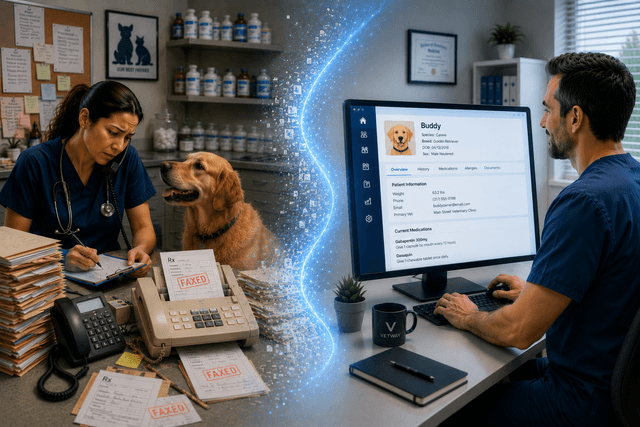
If you've ever worked in both human healthcare and veterinary medicine, one thing becomes obvious pretty quickly: the technology isn't even close.
Human healthcare has spent years investing in digital infrastructure. Today, physicians can send prescriptions electronically, pull up a patient's medication history in seconds, receive refill requests without picking up the phone, and access records from other providers. None of that feels groundbreaking anymore. It's simply expected.
Veterinary medicine, on the other hand, is still relying on workflows that human healthcare moved away from years ago.
Many practices are still printing prescriptions, faxing pharmacies, calling to confirm they received them, and manually documenting every conversation. Those extra steps don't improve patient care. They just take valuable time away from it.
That isn't because veterinary medicine is behind clinically. In fact, veterinarians are providing incredibly advanced care every day.
The real difference is the infrastructure supporting the industry.
Human Healthcare Invested in Connectivity
One of the biggest reasons human healthcare operates more efficiently today isn't because hospitals bought better software.
It's because the systems can actually communicate with one another.
Electronic prescribing, lab integrations, patient records, pharmacy networks, and interoperability standards have been developed over decades. The technology works because everyone is speaking the same digital language.
When information flows easily between providers, pharmacies, and patients, everyone benefits.
Veterinary Medicine Is Still Working Around the Gaps
Veterinary practices often have great software inside their own clinic, but once information needs to leave that system, everything becomes more complicated.
A simple prescription can involve printing paperwork, faxing documents, making phone calls, answering follow-up questions, and manually tracking refill requests.
Multiply that by dozens of prescriptions every day, and those small tasks become a significant administrative burden. None of those steps are why someone became a veterinary technician or veterinarian. They're simply workarounds for systems that were never designed to connect.
Pet Owners Expect More
Technology has changed what people expect from every service they use. They order groceries from their phone, schedule doctor's appointments online, track deliveries in real time, and receive text updates for just about everything they do.
Naturally, they expect a similar experience when caring for their pets. Instead, many still have to wonder whether a prescription was received, whether the pharmacy has it, or when it will be ready. That creates frustration for clients and extra phone calls for veterinary teams.
Veterinary Medicine Doesn't Need to Copy Human Healthcare
Veterinary medicine has different regulations, different workflows, and different challenges than human healthcare. The goal isn't to become another version of the human medical system, but there are lessons worth borrowing.The biggest one is that connected systems make everyone's job easier.
When software communicates seamlessly, practices spend less time on paperwork and more time with patients. Pharmacies receive cleaner information. Clients get better visibility. Everyone spends less time chasing down answers.
That's the direction the industry is already moving.
Building Toward a More Connected Future
As artificial intelligence, automation, and smarter workflows continue to develop, one thing becomes clear: none of those technologies work well without connected data.
Practices shouldn't have to rely on fax machines and phone calls to complete routine tasks.
The more connected the veterinary ecosystem becomes, the more time practices can spend focusing on what actually matters—providing great care for their patients.
How Vetway Fits In
At Vetway, that's exactly the problem we're working to solve.
Our platform helps veterinary practices communicate more efficiently with pharmacies by replacing many of the manual steps involved in prescription management.
Instead of relying on fax machines, repeated phone calls, and disconnected workflows, practices can electronically send prescriptions to participating pharmacies, manage refill requests more efficiently, and keep communication in one place.
The goal isn't just to make prescriptions easier. It's to reduce administrative work so veterinary teams can spend more of their day doing what they are trained to do, which is care for animals.
No single platform will solve every challenge facing veterinary medicine, but improving connectivity is an important step forward.
Human healthcare didn't become digitally connected overnight. It happened through years of investment in infrastructure and collaboration across the industry.
Veterinary medicine is now reaching that same point.
Practices that embrace connected technology today will be better positioned to improve efficiency, meet growing client expectations, and continue delivering outstanding patient care for years to come.
Frequently Asked Questions - FAQ
Why is human healthcare technology more advanced than veterinary medicine?
Human healthcare has benefited from decades of investment in digital infrastructure, interoperability standards, and government initiatives that encouraged electronic health records and e-prescribing. Veterinary medicine has largely evolved independently, leaving many practices to rely on manual workflows like faxing prescriptions and making phone calls.
Why do many veterinary practices still fax prescriptions?
Many veterinary clinics still fax prescriptions because there isn't a universally connected network between veterinary practice management software and pharmacies. Without standardized electronic communication, faxing often remains the most reliable option.
What is electronic prescribing in veterinary medicine?
Electronic prescribing (e-prescribing) allows veterinarians to send prescriptions directly to participating pharmacies through a secure digital platform instead of printing or faxing them. This helps reduce paperwork, improve accuracy, and streamline communication.
How can veterinary practices reduce administrative workload?
Practices can reduce administrative tasks by adopting connected technologies that automate prescription workflows, streamline refill requests, and eliminate repetitive phone calls and faxes. This gives veterinary teams more time to focus on patient care.
How does connected technology improve the client experience?
Connected systems provide faster prescription processing, fewer communication delays, and greater transparency for pet owners. Clients spend less time wondering if their pharmacy received a prescription and practices receive fewer status inquiries.
Is veterinary medicine moving toward digital transformation?
Yes. More veterinary practices are adopting cloud-based software, automation, AI-powered tools, and electronic prescription solutions. As technology continues to evolve, connected systems are expected to play a larger role in improving efficiency across the industry.