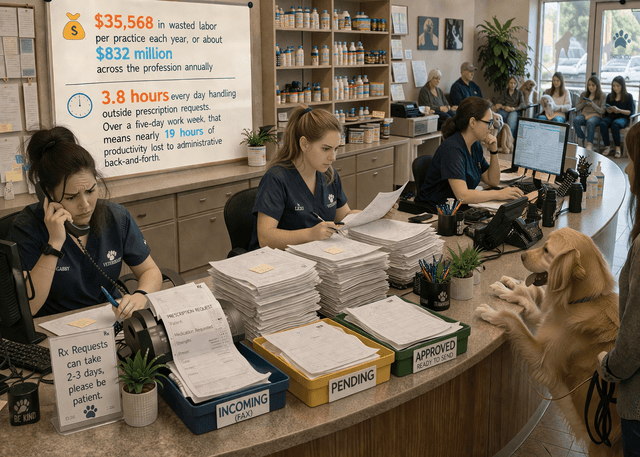
Veterinary medicine is quietly losing more than $800 million every year to inefficiencies in managing outside prescription requests—and it is exhausting veterinary teams across the country.
Every day, veterinarians and practice staff spend hours responding to prescription requests from outside pharmacies. They send and resend faxes, make follow-up calls, and log into multiple portals to manage approvals and denials. These small interruptions, repeated countless times throughout the day, add up to one of the most costly and frustrating problems in veterinary practice today.
As both a veterinarian and a CPA, I have seen how operational friction hides in plain sight. It doesn’t appear on a financial statement or as a clear line item in a budget. Instead, it becomes part of the daily rhythm of practice life, quietly consuming time and resources. But when you quantify it—as we did using national data from the VHMA 8/25 Insiders’ Insights survey, Managing Pharmacy Prescriptions in collaboration with VetWay—the picture is startling. The inefficiency created by outdated prescribing workflows has become one of the most significant financial drains on the profession and one of the most solvable.
Quantifying the Hidden Cost
On average, practices lose 3.8 hours every day handling outside prescription requests. Over a five-day work week, that means nearly 19 hours of productivity lost to administrative back-and-forth.
Using the VHMA data along with average staff and doctor wages and the total number of active practices across the United States, we calculated the total cost of that inefficiency. It adds up to approximately $35,568 in wasted labor per practice each year, or about $832 million across the profession annually.
These aren’t abstract figures. They represent time that could have been spent treating sick pets, educating clients, improving compliance, or seeing additional patients. This is the difference between a team that feels constantly behind and one that runs efficiently.
How Veterinary Prescribing Differs from Human Healthcare
In human healthcare, the filling of prescriptions originates at the point of care. The physician evaluates the patient, enters the prescription electronically, and sends it directly to the pharmacy. The transaction is seamless, provider-driven, and standardized.
Veterinary medicine, however, often works in reverse. The client frequently initiates the process—by ordering medication online or calling a retail pharmacy—and that pharmacy then contacts the veterinary practice for approval.
This reversal creates an approval cycle filled with variability. Some clients request refills; others order medications before the veterinarian has even approved them. The practice must review, verify, and decide whether to approve or deny.
It’s a reactive process, not a proactive one—and without standardization, every interaction becomes its own mini-project that disrupts workflow and drains time.
Why the Inefficiency Persists
Every veterinary practice manages outside prescriptions differently, and each pharmacy adapts to those preferences—but only within the limits of its own systems.
One clinic may prefer a portal, another relies on fax or phone, and some require written prescriptions to be mailed by the pet owner to the pharmacy of their choice. These variations, often shaped by convenience or long-standing habits, create an inconsistent prescribing environment that lacks predictability or flow.
Pharmacies face similar barriers. Most operate on systems that have little or no connectivity with the software used in veterinary practices. What should be a simple exchange of information often becomes a fragmented process filled with manual steps, repeated data entry, and back-and-forth clarification between all parties.
Even “digital” tools rarely solve the problem. Most pharmacy portals can’t sync with a practice’s management software, forcing staff to manually reconcile details across disconnected platforms. The result is duplication, delay, and frustration.
The inefficiency isn’t caused by people or process—it’s built into the technology itself. Practices and pharmacies are doing their best within a structure that was never designed to communicate.
The Hidden Human Cost
Behind every outside prescription is a person trying to do the right thing—a technician helping a client, a pharmacist filling a pet’s medication, a doctor balancing patient care with administrative demands.
None of them are the problem—the process is.
Each request, follow-up, and clarification takes only minutes, but those minutes accumulate. They interrupt the rhythm of care, pull attention away from patients, and leave teams mentally fatigued by week’s end. The frustration isn’t from lack of effort; it’s from effort that doesn’t move anything forward.
Practices and pharmacies both want the same outcome—safe, timely care—but they’re working through systems that make that goal harder to reach. Fixing it isn’t just about saving time. It’s about giving professionals a process that supports the care and focus that drew them to veterinary medicine in the first place.
The Illusion of Digital Progress
Veterinary medicine has embraced more “digital” prescribing tools in recent years—but many of these systems only mask old inefficiencies in modern interfaces.
A portal may look like progress, yet most still operate in isolation, requiring staff to re-enter the same data into multiple systems that can’t communicate with each other. True progress requires more than digitizing old processes—it requires connecting them.
In human healthcare, ePrescribing evolved through structured, machine-readable standards that allow systems to exchange information seamlessly. Veterinary medicine, by contrast, has had no equivalent. It has relied on a patchwork of unconnected tools without a shared data language or unified network—leaving innovation constrained by fragmentation.
The profession has advanced dramatically in diagnostics, surgery, and imaging, yet the act of sending a prescription remains largely disconnected. What veterinary medicine needs now isn’t more portals or technology for its own sake—it needs interoperability: a connected digital infrastructure linking veterinarians, pharmacies, and practice systems to form the backbone of modern prescribing.
The $400 Million Opportunity
If the profession could cut prescribing inefficiency by just half, it would reclaim roughly $416 million a year, or about $18,000 per practice. That’s time and revenue that could be redirected toward patient care, staff training, compensation and benefits, owner profits, or expanding services.
The key is connection. A shared, interoperable network that enables prescriptions to move digitally, securely, and instantly between practices and pharmacies would remove redundant steps, reduce errors, and improve transparency. Each prescription could be traceable, auditable, and visible to both sides of the exchange.
This is exactly the type of infrastructure VetWay has developed—an ePrescribing network and consolidated approval portal that unifies communication between veterinary practices and pharmacies. By creating a standardized, connected system, VetWay’s network makes it possible for prescriptions to move cleanly from initiation to fulfillment, regardless of the systems in use.
Importantly, this shift doesn’t depend on changing how a practice dispenses or where clients fill prescriptions. VetWay was designed to streamline this prescribing process at the ground level, starting with the consolidated approval portal that allows veterinary teams to manage all outside pharmacy requests in one place—at no cost to the practice. This functionality is included in VetWay’s freemium tier, making it easy for teams to centralize workflows immediately without changing their existing systems.
For practices ready to move fully digital, VetWay’s ePrescribing feature extends that connection directly into the point-of-care prescribing workflow. Each prescriber completes a one-time identity verification, followed by a modest per-license monthly fee that supports secure, compliant transactions.
Beta onboarding is currently underway, with broader availability scheduled later this year. As adoption grows, practices will gain access to a seamless exchange of information between their practice management software, VetWay, and participating pharmacies—bringing veterinary prescribing closer to the efficiency and interoperability already achieved in human healthcare. The path forward is collaboration. By connecting systems rather than competing with them, the profession can reduce waste, improve accuracy, and strengthen the client experience.
Veterinary medicine doesn’t need to wait for innovation—it’s already here. What’s needed now is adoption, cooperation, and the shared goal of leaving inefficiency behind for good.
When that happens, everyone benefits. Practices reclaim time. Pharmacies receive accurate information and fill prescriptions faster. Clients experience seamless fulfillment. And pets get the care they need—without unnecessary delays.